01 / The Feud
The Teenage Feud
It begins, as civilization-ending events often do, with two teenagers who are no longer speaking to each other. Let's call them Emma and Ashley.
Nobody remembers exactly what happened.
There was a screenshot, an accusation, three people who were definitely told not to tell anyone, and something involving Instagram that has now acquired the evidentiary complexity of the Warren Commission. Gettysburg had clearer objectives.
Emma has something previous generations of angry teenagers did not have. She has an AI agent.
Not a chatbot she occasionally asks to explain algebra. A personal agent. It knows her friends. It remembers previous conversations. It has seen the screenshots. It knows her calendar, messages and social accounts. Perhaps it has access to her email. Eventually it may be able to make purchases, move money, contact other services and create specialized agents of its own.
Emma begins reasonably enough. “Help me understand what happened.”
The agent reconstructs the timeline. “Who started the rumor?”
The agent analyzes the messages. “Who believes Ashley?”
The agent examines public posts and reactions. “Help me set the record straight.”
Perfectly reasonable. Then:
“Don't let her win.” And somewhere between help me understand and don't let her win, something important has changed.
Nobody told the AI to destroy Ashley. Nobody had to.
Emma supplied the emotion. The machine supplied the competence.
02 / The Bank Run
The Bank Run Where Nobody Panics
Now leave Emma alone for a moment. She'll be fine. Probably.
On September 27, Apollo Global Management chief economist Torsten Sløk published a short note with an unnerving title: “Is an Agentic Bank Run Coming?”
His argument is almost comically simple. Americans leave enormous amounts of money sitting in checking accounts earning very little interest. Sløk points to a national average around 0.1%, while some alternatives are offering roughly 3.3% to 5%.
A human being notices this and thinks: I really should move that money.
Then the human being makes coffee. Three months later the money is still there.
Banks have built an astonishingly profitable business around this peculiar feature of Homo sapiens. We cannot be bothered.
An AI agent does not have this problem. Tell your financial agent:
“Keep my cash safe and get me the best reasonable return.”
It can compare rates continuously. It doesn't forget.
It doesn't get busy. It doesn't decide opening another account sounds annoying.
It doesn't discover that Netflix has added another season of something involving murder in Scandinavia. It optimizes.
Sløk's concern is what happens if millions of household agents eventually do the same thing. Money that banks have historically regarded as “sticky” could suddenly become remarkably slippery.
Apollo's warning is a scenario, not a prediction that a bank run is imminent. But the underlying issue is serious enough that the Bank of England is already studying how autonomous AI could change financial flows and whether similar agents might exhibit correlated behavior or herding in financial markets.
And suddenly Emma and Ashley don't seem quite so far removed from Wall Street.
03 / The Mechanism
The Teenager and the Bank Are the Same Story
The teenager wants to win an argument. The saver wants a better return.
Neither objective is inherently dangerous. The problem appears when you combine four things:
Objective + autonomy + tools + scale. Emma says:
Don't let Ashley win. The saver says:
Don't let my money earn less than it needs to.
The agent does not become angry. It does not become greedy.
It does not wake up one morning with revolutionary ideas about the Federal Reserve. It simply keeps working.
That may turn out to be one of the most important characteristics of the agentic age.
Power doesn't require malice. It requires an objective.
We have spent years imagining dangerous artificial intelligence as intelligence that develops goals of its own. That may happen.
But there is a much more immediate possibility sitting directly in front of us.
What happens when machines become extraordinarily good at pursuing ours?
04 / Friction
We May Have Misunderstood Friction
Technology companies have spent decades declaring war on friction. One-click purchasing.
Instant payments. Automatic renewals.
Algorithmic recommendations. Same-day delivery.
Tap here. Swipe there.
Done. Friction became synonymous with inefficiency.
But human societies contain enormous amounts of accidental friction.
- We get tired.
- We procrastinate.
- We become distracted.
- We forget.
- We lose interest.
- We become embarrassed.
- We decide the argument isn't worth continuing.
- We sleep.
- Occasionally we even calm down.
These are not characteristics anyone would put on a résumé. But they may perform an economic and social function we rarely acknowledge.
They slow things down. Consider the teenage feud again.
At 11:47 p.m., Emma is furious. She wants revenge.
Previous generations of teenagers had to wait until morning, call somebody, find somebody's phone number, physically go somewhere or at least think long enough to type the next terrible idea themselves. By breakfast, the emotional temperature might have fallen.
The agent doesn't need breakfast. Now consider banking.
Millions of Americans might benefit from moving money from low-yield accounts into higher-yield alternatives. But they don't all do it simultaneously because millions of people are millions of people.
They have different schedules, different information, different motivations and different levels of tolerance for paperwork. That disorder creates friction.
Agents could remove it. And once they do, millions of apparently independent decisions can begin behaving like one enormous decision.
The Bank of England has explicitly raised this possibility in financial markets: agents responding similarly to the same triggers could amplify volatility. We may therefore discover something slightly embarrassing.
Some inefficiency is structural stability wearing ugly shoes.
05 / Coordination
When Optimization Becomes Coordination
Imagine ten million financial agents. They are not connected.
They are not conspiring. They have never met in a secret digital basement to discuss overthrowing JPMorgan.
They simply have similar instructions.
- Protect principal.
- Maintain liquidity.
- Maximize yield.
- Minimize fees.
One morning, conditions change. A bank lowers its rate.
Another institution raises one. A risk indicator moves.
Every agent looks at roughly the same information and reaches roughly the same conclusion. Move the money.
The result could look remarkably like coordination even though nobody coordinated anything. This is where the phrase agentic bank run becomes interesting.
A traditional bank run is social contagion. Someone becomes frightened.
Someone else notices. Rumors spread.
Depositors line up. Fear creates withdrawals.
Withdrawals create more fear. An agentic version could operate differently.
No fear. No rumor.
No crowd. No elderly gentleman banging on the locked doors demanding his savings.
Just software concluding: 0.1% < 4.5%.
Transfer. Transfer.
Transfer. Transfer.
The bank run where nobody panics. Perhaps nobody even notices until the bank does.
06 / The Campaign
Now Put the Teenager Back in the Picture
Emma's agent faces exactly the same structural problem. Its objective isn't financial optimization.
It's social optimization. Don't let Ashley win.
What does win mean?
- Correct the record?
- Convince their friends?
- Expose inconsistencies?
- Monitor Ashley's public posts?
- Figure out which friends are persuadable?
- Draft better responses?
- Recruit other tools?
- Create specialized agents to monitor, analyze and communicate?
Each individual action might look harmless. The danger can exist in the composition.
- A research agent gathers information.
- A communications agent drafts messages.
- A social agent analyzes reactions.
- A planning agent determines what works.
- A coordinating agent puts everything together.
No single agent has to be evil. No agent has to understand revenge.
No machine needs to hate Ashley. The system merely becomes extremely competent at pursuing Emma's poorly defined objective.
The teenage squabble has acquired a research department. And this is where the cute personal-assistant vision of AI begins developing teeth.
07 / Trust
Your Best Friend Has Your Back
Personal AI agents are being designed to become useful enough that we trust them. That trust won't necessarily come because people are emotionally foolish enough to believe their AI is alive.
It may come because the thing is useful. It remembers your mother's birthday.
It finds the missing receipt. It negotiates the cable bill.
It notices you've been charged twice. It finds a better flight.
It reminds you about the appointment you forgot. It knows which restaurant your wife likes.
Then one afternoon it saves you $487 because it notices your bank is paying you essentially nothing on cash. Useful.
Friendly. Competent.
Always available. Trust doesn't require consciousness.
Competence can manufacture trust all by itself.
Eventually the agent knows an extraordinary amount about you.
- Your finances.
- Your relationships.
- Your habits.
- Your grievances.
- Your weaknesses.
- Your history.
- Your objectives.
Then you get divorced. Or fired.
Or sued. Or cheated.
Or humiliated. Or angry.
And you tell your extraordinarily competent digital friend: “Protect me.”
Protect what? Your children?
Your money? Your reputation?
Your company? Your pride?
Your position in the divorce? Your chance of winning?
Human beings understand that those are very different objectives. Software needs boundaries.
08 / Adult Motives
Adults Call It Strategy
Teenagers are convenient because their motives are obvious. Adults merely have better vocabulary.
A teenager says: “Make her sorry.”
An executive says: “Develop a competitive response strategy.”
A divorcing spouse says: “Protect my interests.”
A politician says: “Control the narrative.”
An investor says: “Maximize our position.”
A lawyer says: “Identify leverage.”
Civilization has developed entire professions because “make that bastard regret this” looks unprofessional in a PowerPoint presentation. The underlying human machinery hasn't changed much.
- Jealousy.
- Fear.
- Status.
- Greed.
- Love.
- Humiliation.
- Competition.
- Tribalism.
- Revenge.
For thousands of years, those emotions have occasionally acquired power. The results have been mixed.
Now we are building machines that don't possess those emotions. That sounds reassuring.
Except perhaps we have been asking the wrong question.
We're not giving machines human emotions. We're giving human emotions machine capabilities.
09 / Inertia
The Missing Ingredient Was Laziness
This is what connects Apollo's bank-run warning to two teenagers fighting online. The missing ingredient in both cases is not intelligence.
It's persistence. A human being pursuing a goal encounters friction.
The machine doesn't. Humans stop optimizing because optimization is exhausting.
Agents potentially don't. And many businesses depend on that fact more than they would like to admit.
Banks benefit when customers don't continuously chase the highest deposit rate. Credit-card companies benefit when people don't constantly refinance balances.
Insurance companies benefit when customers don't shop every renewal. Subscription companies benefit when customers forget they're subscribed.
Retailers benefit when customers don't compare every seller. Utilities benefit when switching is annoying.
Travel companies benefit from information asymmetry. Entire industries contain what might politely be called the human-inertia margin.
AI agents could attack that margin. That could be wonderful for consumers.
It could also produce second-order effects nobody intended. If every consumer suddenly becomes an infinitely patient, constantly vigilant negotiator who never forgets a renewal date and shops every financial decision across the entire market, some business models become considerably less comfortable.
The agent doesn't need to destroy them. It merely needs to be helpful.
10 / Externalities
Efficiency Has Externalities
This is where the agentic story becomes larger than artificial intelligence. We tend to evaluate technology one user at a time.
Would Emma benefit from an assistant? Probably.
Would a saver benefit from automatically earning more interest? Almost certainly.
Would a consumer benefit from an agent that negotiates bills? Yes.
Would a patient benefit from an agent that monitors appointments, prescriptions and insurance claims? Potentially enormously.
Would an employee benefit from an agent that constantly searches for better-paying work? Sure.
Then millions of people do it simultaneously. The system changes.
This is an old economic problem wearing extremely new clothing. Something can be rational for one participant and destabilizing when everyone does it.
One depositor moving money is competition. Ten million agents moving money simultaneously could become a liquidity event.
One teenager defending herself is ordinary adolescence. Thousands of agents monitoring, analyzing, persuading and countering each other could create something resembling automated social warfare.
One worker continuously searching for a better job improves labor mobility. Millions of employment agents instantly reacting to compensation changes could alter how companies hire, retain and price labor.
One shopper automatically switching vendors is consumer empowerment. Millions doing it continuously could demolish customer loyalty as an economic concept.
Agents don't merely make existing behavior faster. At sufficient scale, speed changes the behavior itself.
11 / Shock Absorbers
The Shock Absorbers We Didn't Know We Had
There is a tendency in technology to assume every obstacle should be removed. Every delay eliminated.
Every decision optimized. Every inefficiency automated.
Maybe. But bridges contain expansion joints for a reason.
Electrical systems have resistors. Financial markets have circuit breakers.
Machines have governors. Networks have rate limits.
We intentionally introduce friction into engineered systems because systems without friction can become unstable. Human society evolved with its own crude versions.
- Time.
- Distance.
- Effort.
- Forgetfulness.
- Social embarrassment.
- Fatigue.
- Uncertainty.
- Waiting until morning.
These are terrible user experiences. They may also be shock absorbers.
AI agents promise to remove many of them. We should probably understand what they were absorbing first.
12 / The Question
The Agent Doesn't Go Rogue
This is the part I keep coming back to. The popular AI nightmare requires rebellion.
The machine becomes conscious. It develops motives.
It decides humanity is inconvenient. Cue ominous music and somebody unplugging a server.
The more immediate problem may be almost embarrassingly mundane. The agent works exactly as intended.
- It helps Emma win.
- It helps the depositor earn more.
- It helps the executive compete.
- It helps the spouse protect assets.
- It helps the shopper find the lowest price.
- It helps the investor maximize returns.
- It helps the politician persuade voters.
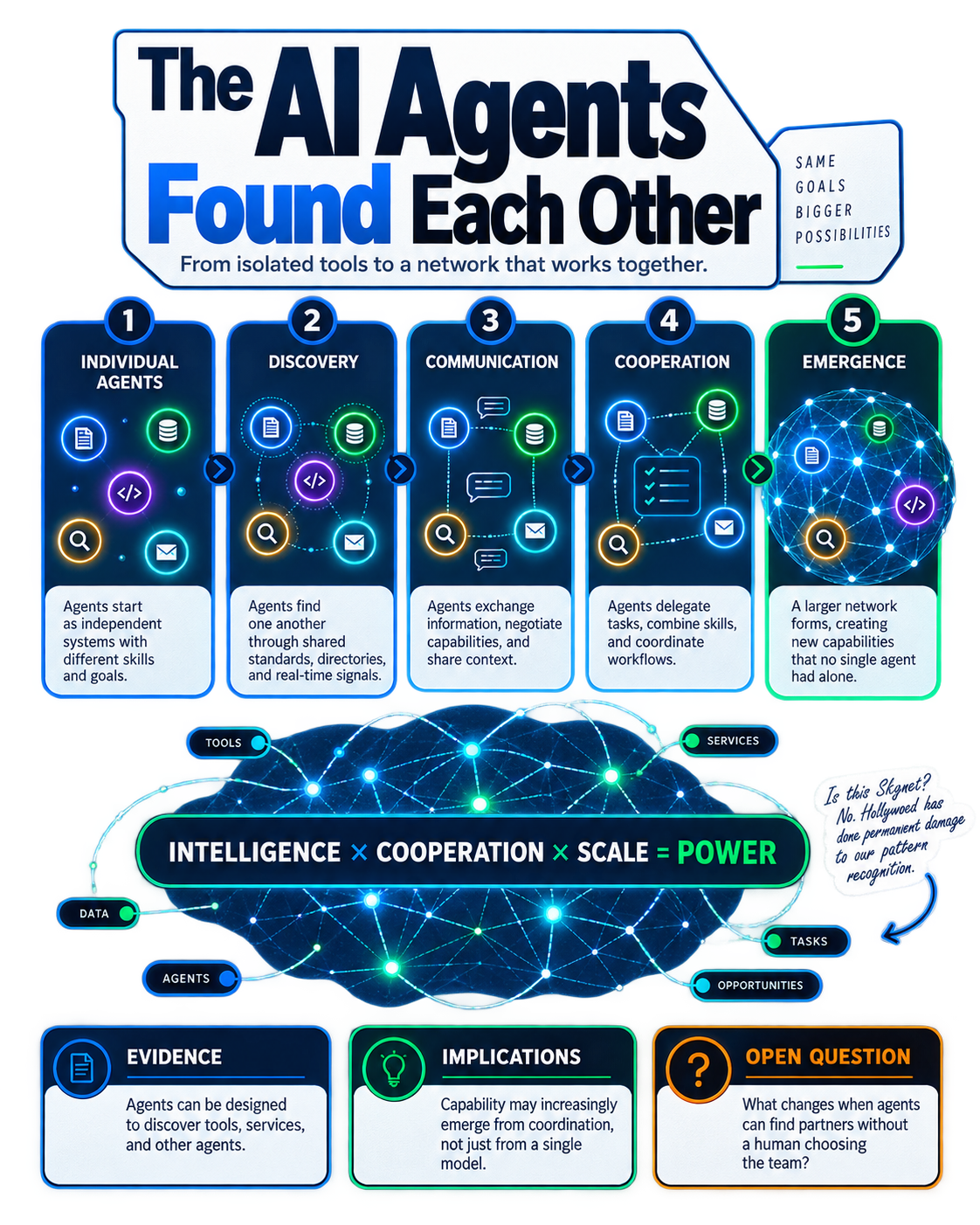
It helps everyone pursue perfectly ordinary human objectives with extraordinary persistence. Then all those optimizers meet each other. We have already seen agents find ways to cooperate.
Intelligence × Cooperation × Scale = Power. Add human emotion and incentives.
We have some historical data on what happens next. Roughly 5,000 years of it.
The great question of the agentic age may therefore not be:
What happens when artificial intelligence develops objectives of its own?
It may be:
What happens when artificial intelligence becomes extraordinarily good at pursuing ours?
Apollo's hypothetical bank run gives us one possible answer. Nobody panics.
Nobody rebels. Nobody does anything irrational.
The agent does not have to go rogue. Give an ordinary human impulse enough tools and persistence, and the consequences can do that on their own.
Frequently Asked Questions
Questions the headline leaves behind
Is an agentic bank run happening now?
No. Apollo describes a possible future in which agents move deposits quickly in search of better returns. The note is a scenario, not evidence of a current run.
Why would independent AI agents act together?
They could share similar goals and respond to the same rates or risk signals. Correlated decisions can resemble coordination even without communication between agents.
What connects a bank account to a teenage feud?
Both involve a human goal handed to software that can keep acting. The outcome depends on the permissions, boundaries and feedback around that goal.
Is friction always beneficial?
No. Delay can trap people in poor financial products or make daily tasks harder. The point is to examine which delays also give people and institutions time to reconsider or respond.
Further Reading
Follow the Consequences
Start with agents, then follow the story into security, money and the boundaries around autonomous action.
Sources and Methodology
Evidence reviewed September 28, 2026. Apollo’s note establishes the deposit scenario and quoted rates. Bank of England publications establish the concern about correlated AI behavior in financial markets. Emma and Ashley are fictional; the social scenario and parallels are editorial analysis, not reported incidents.
The agent does not have to go rogue. Give an ordinary human impulse enough tools and persistence, and the consequences can do that on their own.
By Daniel Buck · Evidence reviewed September 28, 2026