The automobile industry spent more than a century perfecting the art of building machines with wheels.
Now, apparently dissatisfied with the complexity of that business, it has decided to add legs.
Chinese automaker XPeng just raised more than $900 million for its robotics division, valuing the operation at more than $6.3 billion. Hyundai plans to begin U.S. robot production in 2028. Tesla continues to insist that Optimus could someday become more valuable than its car business. Chery, BYD, Changan, GAC, Li Auto, SAIC and Seres are all developing humanoid robots or related robotics operations.
This is no longer a collection of eccentric side projects.
The car industry is quietly becoming the robot industry.
And there is a reason.
Actually, several.
The Car Business Has Become Brutal
Start with the least romantic explanation.
Cars are becoming a lousy business.
Not universally. Not permanently. And certainly not for every manufacturer. But the modern automobile industry, especially in China, has become an astonishingly efficient machine for compressing its own profit margins.
Electric vehicles brought dozens of competitors into the market. China built enormous manufacturing capacity. Price wars followed. Consumers benefited. Automakers developed ulcers.
Michael Dunne, the automotive consultant who watches China’s industry closely, recently described the attraction of robotics in wonderfully uncomplicated economic terms. XPeng founder He Xiaopeng sees razor-thin profits in cars on the horizon. Robots look much more promising.
That may be the whole story in miniature.
For a century, the automobile was one of the greatest industrial products ever invented. It was expensive, complicated, aspirational, indispensable and endlessly replaceable.
What more could capitalism ask?
Unfortunately, capitalism eventually asks for margin.
And mature industries have a nasty habit of becoming efficient enough that extraordinary products turn into ordinary businesses.
The automobile may be approaching that stage.
Humanoid robots, by contrast, sit comfortably inside the glorious early phase of an industry when nobody knows exactly what the product should cost, how large the market will become, who will dominate it, or whether any of the forecasts make contact with reality.
Investors love this phase.
Reality has not yet had enough time to prepare an invoice.
XPeng Is Not Dabbling
XPeng’s move deserves particular attention because this is not the corporate equivalent of putting a robot in the lobby and asking journalists to admire it.
The company’s robotics unit raised more than $900 million in its first outside financing round. Investors included IDG Capital, Tencent, Alibaba and Gaorong Ventures. XPeng says the money will go toward robotics hardware, software, physical AI training data, production facilities and international expansion.
The company wants to produce 1,000 IRON humanoid robots per month by the end of 2026.
Commercial sales are supposed to begin in 2027.
Founder He Xiaopeng is personally taking control of the robotics operation.
That is the part worth circling.
Executives do not normally take personal control of a division because they think it will make an amusing booth at CES.
XPeng believes this might become a business.
Possibly a very large one.
Why Automakers?
At first, the sudden enthusiasm for humanoids might look like another corporate fever.
Artificial intelligence arrived. Every company required an AI strategy.
Then agents arrived. Every company required an agent strategy.
Now humanoids are arriving and apparently the legal department has been instructed to prepare for ankles.
But automakers have legitimate structural advantages in robotics.
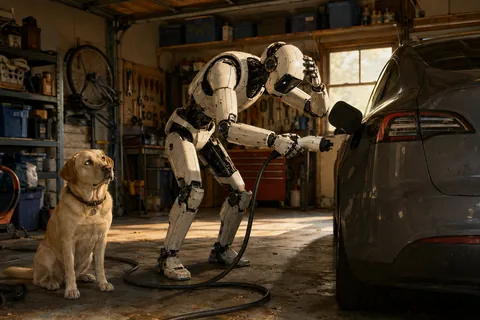
An electric autonomous vehicle is already a kind of robot.
It has batteries.
Electric motors.
Power electronics.
Sensors.
Cameras.
Computers.
Control systems.
AI software.
Precision manufacturing.
Complex supply chains.
Safety engineering.
Mass production.
Take away four wheels, add two legs and a pair of hands, and you have not created an entirely different industrial problem.
You have created a much more annoying version of one the automobile industry already understands.
This is especially true in China, where the electric vehicle boom created a deep supplier ecosystem for batteries, motors, sensors, actuators and electronics. Those same capabilities are useful for robots.
The modern EV industry may accidentally have spent fifteen years building the supply chain required for humanoids.
That is not a small advantage.
The Factory Is Already There
Then there is manufacturing.
Robot startups face a problem familiar to anyone who has ever tried to turn a prototype into a product.
Building one is difficult.
Building 100,000 identical ones without half of them acquiring mysterious personality disorders is something else.
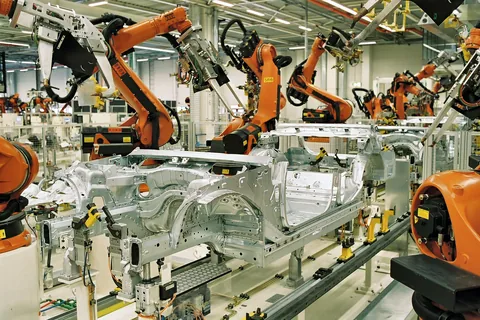
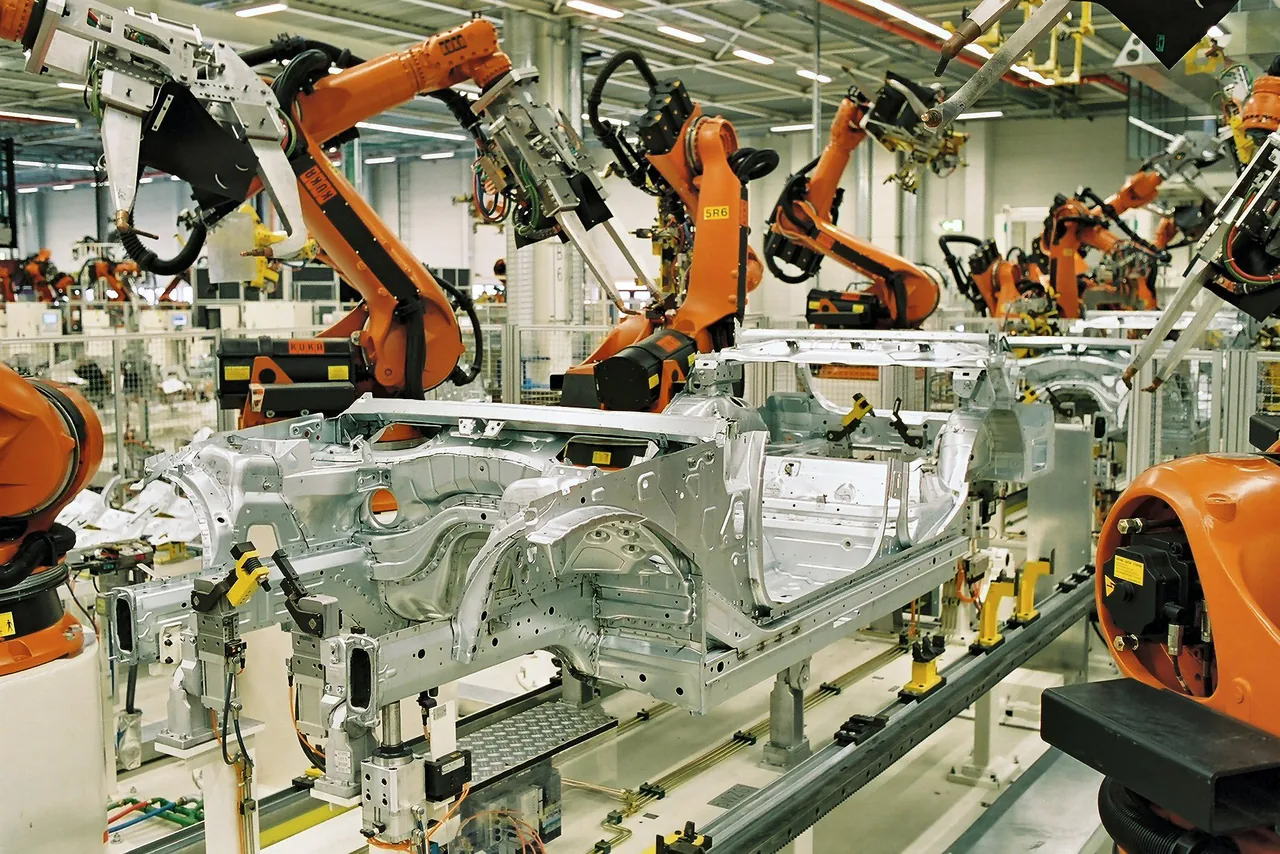
Automakers already know how to manufacture complicated electromechanical systems by the hundreds of thousands.
They know quality control.
Supplier management.
Warranty reserves.
Service networks.
Parts logistics.
Financing.
Regulatory compliance.
All the dull things that become fantastically important approximately six minutes after the prototype leaves the laboratory.
Silicon Valley loves invention.
Detroit, Toyota City, Seoul and Shenzhen understand production.
The humanoid robot race may eventually discover that the second skill is at least as important as the first.
Hyundai Has Already Reached the Boring Questions
Hyundai may be the clearest example of where this is going.
It owns Boston Dynamics.
That means it owns Atlas, Spot and Stretch, three machines with rather different ideas about what a robot should look like.
Hyundai plans U.S. robot production beginning in 2028 and intends to deploy Atlas humanoids in its Georgia manufacturing operations.
But the interesting part is not Atlas learning to work in a factory.
Hyundai has begun discussing distribution.
Dealerships.
Service.
Financing.
Hyundai Capital could theoretically finance robot purchases just as it finances cars.
This may sound like administrative trivia.
It is not.
The robot industry’s missing invention may be the monthly payment.
A $75,000 robot is an intimidating capital purchase.
A monthly payment compared against the monthly cost of labor suddenly creates a completely different conversation.
That is when a humanoid stops competing with another machine and begins competing with a payroll line.
It is also where automakers possess a century of experience.
Tesla Saw the Possibility Early
Elon Musk has spent years predicting that Tesla’s Optimus robot could eventually become more valuable than its automobile business.
That prediction is easy to mock because Musk occasionally treats calendars as an unnecessarily rigid social construct.
But the underlying industrial thesis deserves more respect than the timeline.
Tesla already builds batteries, motors, power electronics, AI computers and vehicles at enormous scale.
Its autonomous driving work generates expertise in perception and machine decision-making.
Its factories provide environments where robots can be tested on actual work.
And unlike a pure robotics startup, Tesla does not have to invent an entire industrial organization from nothing.
Neither does Hyundai.
Neither does XPeng.
Neither does BYD.
That may become increasingly important as the humanoid industry moves from impressive demonstrations toward the considerably uglier problem of commercial deployment.
Unfortunately, the Robots Still Aren’t Very Good at Jobs
Now comes the adult supervision.
The automobile industry’s manufacturing advantages do not solve the fundamental problem with humanoid robots.
Most of them still cannot do enough useful work.
Reuters recently examined China’s humanoid boom and found more than 150 companies competing in the field, backed by substantial government spending and industrial policy.
The hardware is improving quickly.
The intelligence is not keeping pace.
Today’s humanoids can dance, fight, run and generate marvelous video clips.
Factories remain less impressed.
Conventional industrial robot arms are often faster, cheaper, more reliable and perfectly content to spend their entire lives bolted to the floor.
A humanoid has to justify its complexity.
Two legs introduce balance problems.
Hands introduce manipulation problems.
General-purpose movement introduces perception problems.
And the physical world contains an endless supply of objects that bend, slip, deform, jam, move unexpectedly or were left in the wrong place by someone named Steve.
A robot that works beautifully in a demonstration can become strangely philosophical when confronted with a damaged cardboard box.
The Legs May Be the Least Interesting Part
This raises a wonderfully awkward possibility.
What if the winning humanoid does not need to look much like a human?
Factories are flat.
Wheels work extremely well on flat surfaces.
Robotic arms already perform many jobs.
Several companies are therefore developing mobile manipulators with humanoid upper bodies mounted on wheeled bases.
Less cinematic.
Possibly more rational.
The robotics industry has become fascinated with reproducing the human form because the physical world was built for humans.
Doors, tools, stairs, shelves and workstations all assume something roughly our size and shape.
That logic is sound.
But capitalism has no emotional attachment to knees.
If a wheeled robot can perform the job more cheaply than a biped, the factory manager is unlikely to demand anatomical purity.
The Real Prize Is Labor
Why endure all this complexity?
Because the potential market is staggering.
Cars are sold to consumers and businesses.
Labor is purchased by nearly every organization on Earth.
A commercially useful general-purpose robot is not merely another product category.
It is a machine capable of competing in the labor market.
That is why the forecasts become enormous so quickly.
A robot capable of useful work in warehouses, factories, hotels, hospitals, restaurants, elder care and homes does not need to capture the entire workforce to create a gigantic industry.
It only needs to become economically useful in a few large categories.
And it does not necessarily need human-level intelligence.
This is one of the most important points in the entire humanoid debate.
The robot does not have to become as capable as a human.
It has to become capable enough.
If a machine performs 80 percent of a worker’s output at 40 percent of the cost, Accounting may display considerably more enthusiasm than the engineering department.
Economic disruption rarely waits for philosophical perfection.
The Labor Shortage Could Be the Trojan Horse
The first large deployments may also arrive through jobs employers cannot fill.
Manufacturing companies already report shortages in certain occupations. Aging populations in China, Japan, South Korea, Europe and the United States intensify the problem.
That gives robotics companies a politically convenient entry point.
The robot is not replacing anyone.
It is filling the job nobody wants.
At first.
But once the technology, economics and service infrastructure work for vacant positions, there is no magical barrier preventing the same machine from eventually competing for occupied ones.
The labor shortage may become robotics’ training wheels.
China Could Have the Manufacturing Advantage and Still Lose the Brain Race
China currently possesses an extraordinary robotics hardware advantage.
Its manufacturers can build machines quickly and cheaply. Its supplier ecosystem is deep. Government policy encourages embodied AI. Manufacturing provides abundant places to test machines.
But useful humanoids need more than hardware.
They need physical intelligence.
Robots must perceive unfamiliar environments, manipulate objects, recover from mistakes and learn new tasks.
That is where American AI companies remain formidable.
The eventual competition may therefore split strangely.
China builds bodies.
America builds brains.
Then everyone spends the next decade trying to acquire the other half.
Automakers sit directly in the middle of that contest because they already combine physical machinery with increasingly sophisticated AI.
Maybe the Car Was the Transitional Species
There is a larger historical possibility here.
The automobile may eventually look less like the final product of the industrial age and more like a transitional species.
Cars taught companies how to mass-produce complicated mobile machines.
Electric vehicles added batteries, software and powerful computers.
Autonomous driving added perception, machine learning and decision-making.
Humanoid robots add manipulation and general-purpose physical work.
Seen from that perspective, the industry’s evolution looks almost logical.
Mechanical vehicle.
Electric vehicle.
Autonomous vehicle.
Autonomous machine.
The machine no longer needs the road.
It goes to work.
The Margin Fantasy Is Almost Too Attractive
There is another reason automakers cannot stop looking at robots.
Software.
A car is sold once, then manufacturers spend years trying to invent reasons to keep charging the owner. Heated seats became subscriptions. Driver assistance became subscriptions. Connectivity became subscriptions. The automobile industry discovered recurring revenue and immediately began behaving like a software company that had accidentally swallowed a transmission.
Humanoid robots may offer a cleaner version of the same dream.
Sell the hardware.
Then sell intelligence.
New skills.
Improved models.
Fleet management.
Maintenance.
Training.
Monitoring.
Perhaps insurance.
Perhaps financing.
Perhaps a monthly bill for the privilege of having your $80,000 employee remember how to unload the dishwasher after the latest software update.
XPeng executives have already suggested that robotics could eventually carry significantly better margins than automobiles. That remains a forecast, and forecasts about humanoid robots currently reproduce with the enthusiasm of rabbits. Still, the economic logic is obvious.
A robot could combine the manufacturing economics of a vehicle with the recurring revenue economics of software.
That is almost offensively attractive to an automaker.
It also explains why the companies may tolerate years of expensive experimentation. The prize is not simply selling another machine. It is creating a machine whose capabilities can continue changing after the sale.
The car business learned to update the dashboard.
The robot business may update the worker.
That introduces its own delightful collection of problems. Who owns a skill downloaded onto a machine? Can a manufacturer disable functionality when the subscription ends? Does a used robot retain the software purchased by the previous owner? What happens when a safety update makes the machine slower but less inclined to put a forklift through Accounting?
We are not remotely ready for these questions.
Which usually means the market will arrive shortly.
But Let’s Not Build the Retirement Home for Humanity Yet
The hype remains enormous.
Unitree’s spectacular public-market debut was followed by a sharp decline as investors rediscovered the existence of revenue, profit and commercial usefulness.
China may manufacture humanoids at enormous scale before the machines are ready for mass deployment.
XPeng’s $6.3 billion robotics valuation assumes a future that has not arrived.
Tesla’s Optimus timelines continue to migrate.
Hyundai’s Atlas plans remain plans.
And nobody has yet demonstrated a general-purpose humanoid that can economically perform a wide range of jobs with the reliability businesses require.
That matters.
The automobile companies could be brilliantly positioned for the next great industrial market.
They could also be chasing the same magnificent hallucination simultaneously.
Corporate history has examples of both.
The Question Is No Longer Why Automakers Are Building Robots
That part increasingly makes sense.
They have factories.
Suppliers.
Batteries.
Motors.
AI expertise.
Distribution.
Service organizations.
Financing.
And perhaps most importantly, they have a mature core business where competition is steadily squeezing margins.
Robotics offers something the automobile industry has not enjoyed for generations.
A new frontier.
The better question is whether humanoid robotics eventually becomes a separate industry at all.
Perhaps the companies best positioned to dominate it are already sitting in enormous factories stamping metal, assembling battery packs and wondering what comes after the car.
Tesla thinks it knows.
Hyundai thinks it knows.
XPeng just raised $900 million because investors think it might know.
China’s other automakers are rapidly arriving at the same conclusion.
For more than a century, the automobile industry built machines that carried humans to work.
Its next business may be building machines that go to work instead.
The car may not be dying.
It may simply be growing arms.
Questions the headline leaves behind
Why are automakers building humanoid robots?
They already possess much of the relevant industrial machinery, battery expertise, motors, sensors, control systems and manufacturing capacity. Robotics also offers a possible growth market beyond increasingly competitive cars.
Are humanoid robots already useful in factories?
Some systems can perform bounded tasks in controlled environments, but broad, dependable usefulness remains limited. A demonstration is evidence of capability, not proof of economical operation across an entire shift.
Will humanoid robots replace factory workers soon?
Not as a single sudden event. Adoption is more likely to proceed task by task, beginning with repetitive or hazardous work where the environment can be controlled.
Why build a humanoid instead of a specialized machine?
Factories and workplaces were designed around human bodies. A humanoid form may navigate that infrastructure without rebuilding everything, although the flexibility comes with extraordinary engineering complexity.