Elon Musk wanted more artificial intelligence.
Somehow this ended with a foundry.
Not a metaphorical foundry. Not some Silicon Valley "idea foundry" populated by beanbags and men explaining disruption to one another.
An actual foundry.
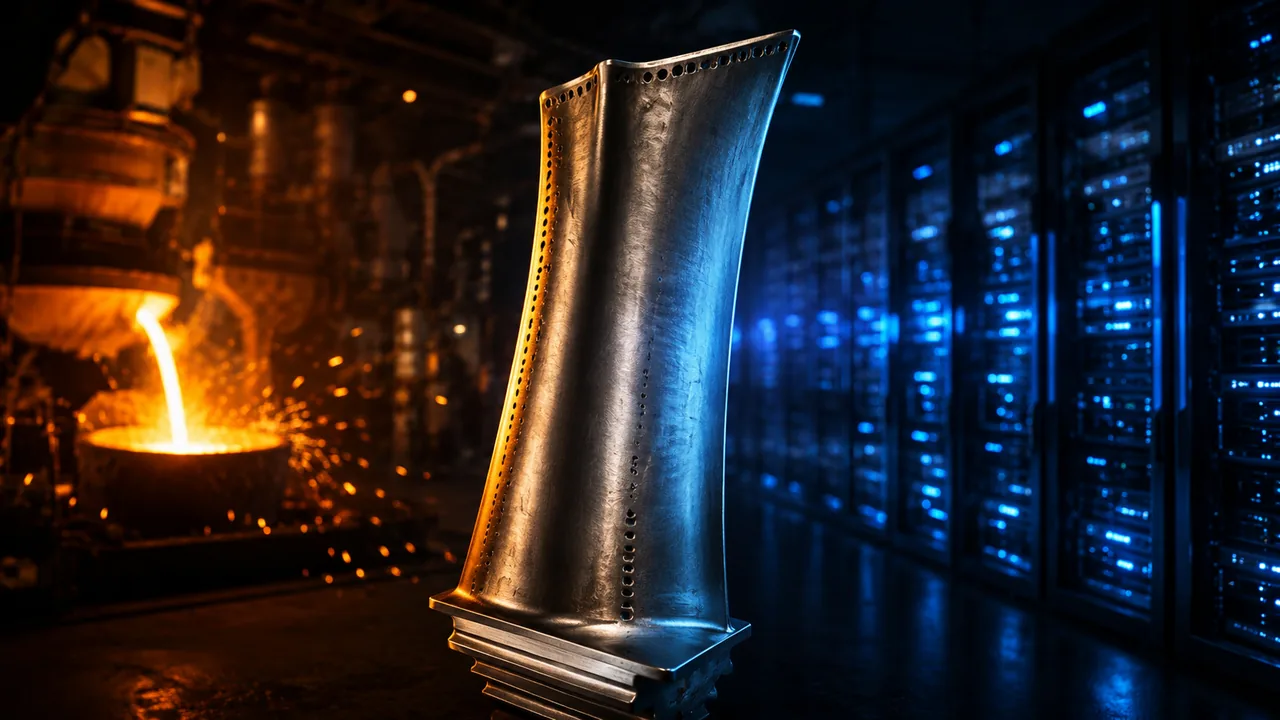
SpaceX is laying the groundwork in Bastrop, Texas, for an operation capable of manufacturing blades and vanes used inside industrial gas turbines, according to reporting first published by The Information and subsequently confirmed by Elon Musk.
The reason is artificial intelligence.That sentence is worth sitting with for a moment.
The technology industry has spent the last several years presenting AI as something approaching pure thought. Models live in "the cloud." Intelligence emerges from mysterious arrays of GPUs. Chatbots answer questions instantaneously from somewhere beyond the mortal plane.
- Except the cloud has developed a natural-gas problem.
- And the natural-gas problem has developed a turbine problem.
- And the turbine problem has developed a blade problem.
- And the blade problem has developed a metallurgy problem.
- Welcome to artificial intelligence in 2026.
Apparently, the future requires a furnace.
The chain now becomes
AI
→ models
→ GPUs
→ data centers
→ electricity
BUILD MORE POWER
→ gas turbines
→ turbine blades
→ nickel superalloys
→ metallurgy
or
MOVE THE COMPUTE
→ flexible workloads
→ demand response
→ grid orchestration
→ software
Digital Dynamics
Follow the Bottleneck
Start with the thing everyone is talking about. Keep drilling until you find the thing nobody is talking about that actually makes it possible.
Keep Digging
There is no bottom. Every technological abstraction eventually resolves into materials, factories, geography and politics.
Apparently, the artificial-intelligence revolution was a metallurgy story all along.
Level One: AI
Start at the glamorous end.
Artificial intelligence.
This is where virtually all public attention lives.
OpenAI releases a new model. Google answers. Anthropic releases another Claude. xAI pushes Grok. Benchmarks appear. Benchmarks are disputed. Somebody's model is 11 percent better at a test nobody outside the AI industry had heard of six months earlier.
All of this creates the impression that the AI race is fundamentally a race of algorithms.
It isn't anymore.
A brilliant model without enough computing infrastructure is a very expensive collection of mathematical ideas waiting for a computer.
The AI companies therefore need chips.
Lots of them.
Level Two: Models Need Compute
The extraordinary improvements in frontier AI have been accompanied by extraordinary increases in computation.
Training requires enormous clusters of accelerators. Running the resulting models for hundreds of millions of users requires another enormous layer of computing infrastructure.
Reasoning models make the problem particularly interesting because computation isn't confined to training. The machine can consume substantial computing resources while producing an answer.
- More users.
- More agents.
- More video generation.
- More reasoning.
- More inference.
- More compute.
And that brings us to the object that briefly became the most famous piece of silicon on Earth.
Level Three: GPUs
For much of the AI boom, the obvious bottleneck was Nvidia.
- Could Nvidia manufacture enough AI accelerators?
- Could TSMC manufacture enough advanced chips?
- Could suppliers produce enough high-bandwidth memory?
- Could advanced packaging capacity keep up?
The industry responded with staggering investment.
And gradually another problem emerged. You can buy the GPUs. Now where are you going to put them?
A million high-performance chips sitting on pallets do not constitute artificial intelligence.
They constitute extremely expensive pallets. The chips need servers, networking, cooling, storage and buildings capable of containing all of it.
The AI bottleneck moved downward again.
Level Four: Data Centers
The AI industry is now engaged in one of the largest infrastructure construction booms in modern history.
Reuters reported on September 1 that McKinsey estimates nearly $7 trillion in global data-center investment through 2030, while manufacturers of transformers, power equipment and cooling systems are already riding the resulting order boom. Reuters' examination of the industries underneath the AI data-center boom
But a data center isn't simply a warehouse where GPUs go to think.
- It is an industrial facility.
- It requires transformers.
- Switchgear.
- Cooling systems.
- Pumps.
- Backup generation.
- Transmission equipment.
- Miles of cable.
- And extraordinary amounts of electricity.
This is where the supposedly weightless AI revolution begins gaining weight rather quickly.
- Steel.
- Copper.
- Concrete.
- Water.
- Land.
- Power.
- Lots and lots of power.
- The bottleneck moves again.
Level Five: Electricity
This may be the defining constraint of the next phase of artificial intelligence.
The U.S. Energy Information Administration says data centers are now helping drive a return to sustained growth in American electricity demand after years of relatively little growth. EIA's 2026 analysis specifically identifies expanding data-center loads as a significant reason electricity demand is accelerating. U.S. Energy Information Administration analysis of data centers and electricity demand
The Department of Energy has reached the same basic conclusion from another direction. DOE says AI and data-center expansion are significant factors behind rising near-term electricity demand and cites estimates that data centers could consume as much as 9 percent of U.S. electricity generation annually by 2030. Department of Energy analysis of data-center electricity demand
AI companies can build computing infrastructure faster than much of the American electrical system can accommodate it.
That mismatch is becoming extraordinary.
Texas regulators are currently confronting electricity requests associated with data centers that have become so enormous that officials have begun questioning how many proposed projects are genuine.
Utilities have a wonderfully appropriate term for the questionable portion:
ghost demand.
Reuters reported on September 1 that proposed U.S. data-center connection requests exceed 700 gigawatts, far beyond credible near-term construction, leading Texas and other states to impose tougher requirements intended to separate serious projects from speculative reservations. Reuters investigation into data-center "ghost demand"
Even after removing the ghosts, however, the underlying problem remains very real.
Data centers require enormous quantities of reliable electricity, and electrical grids were not designed around the assumption that someone might suddenly construct the equivalent of a small city's electricity demand beside a warehouse.
Musk encountered this problem early.
When xAI built its Colossus computing operation around Memphis, grid electricity wasn't available quickly enough at the scale the company wanted.
So xAI did something characteristically impatient.
It brought electricity with it.
Bring Your Own Power Plant
Mobile natural-gas turbines were installed to provide electricity for the computing infrastructure.
That eventually grew into something much larger.
SpaceXAI says 69 temporary mobile turbines have been operating at its Southaven, Mississippi, facility while the company constructs a permanent 1.2-gigawatt power plant consisting of 41 turbines. The company says those temporary units will be removed as the permanent plant comes online. SpaceXAI's official Memphis-area power update
The temporary installations have also generated controversy over air pollution, permits and regulatory treatment.
Those questions deserve their own investigation.
And we'll return to them.
But economically, Musk demonstrated something important.
- The electrical grid did not necessarily have to determine the speed of AI construction.
- If the grid couldn't supply electricity quickly enough, a company with enough money could build generation behind the meter.
- Problem solved.
Except this is artificial intelligence.
Problems do not appear to get solved anymore. They reproduce.
Level Six: Gas Turbines
Once hyperscalers began looking seriously at dedicated power generation, another uncomfortable fact became apparent.
Everyone wants turbines. And the most recent numbers are considerably more dramatic than they were even a few months ago.
GE Vernova reported on July 22 that its combined Gas Power equipment backlog and slot reservations had risen to 116 gigawatts, up from 100 GW only one quarter earlier. The company now expects that figure to reach at least 125 GW by the end of 2026.
GE Vernova is expanding production in response, targeting annual gas-turbine output of 24 GW in 2028 and 30 GW by 2030. GE Vernova's latest gas-turbine backlog and production figures
Think about what that means. The AI industry escaped one queue and joined another.
Instead of asking:
When can the utility connect us?
The question became:
When can someone deliver the turbine?
This is where Musk's strategy gets interesting. Rather than simply accepting that external manufacturing determines his deployment calendar, he is pushing farther upstream.
And eventually you reach the difficult things inside the turbine. Follow the bottleneck.
Level Seven: Turbine Blades
A gas turbine sounds conceptually simple.
- Burn fuel.
- Create hot expanding gas.
- Spin turbine.
- Generate electricity.
Physics professors may now send angry letters.
But the basic idea is straightforward.The engineering is anything but.
The hottest sections of modern turbines operate in conditions hostile to practically everything humans normally build things from.
Blades must withstand extraordinary temperature, enormous centrifugal forces, oxidation, vibration and repeated thermal stress while spinning at high speed.
The Department of Energy's ARPA-E program describes turbine blades as carrying the greatest operational burden among hot-section components because they simultaneously experience extreme temperature and mechanical stress.
Modern high-performance blades commonly use single-crystal nickel or cobalt-based superalloys. ARPA-E explanation of advanced gas-turbine materials
A blade failure inside a large turbine is therefore not the sort of mechanical event followed by someone calmly reaching for a screwdriver.
These things are feats of materials science.And their manufacture is one of the constraints affecting turbine production.
According to The Information's reporting, Musk says SpaceX believes bringing blade and vane casting in-house could accelerate new gas-turbine deployment by as much as 18 months. The original turbine-foundry investigation from The Information
Eighteen months is an eternity in the current AI race.
An AI company capable of powering a new computing cluster a year and a half earlier than a competitor doesn't merely receive electricity sooner.
It receives time. And time may currently be one of the most valuable commodities in artificial intelligence.
These Are Not Ordinary Pieces of Metal
This is where anyone imagining SpaceX opening a glorified machine shop should reconsider.
High-performance turbine blades can be manufactured from nickel-based superalloys engineered specifically to retain strength under temperatures and stresses that would make ordinary metals reconsider their career choices.
Some of the most advanced blades are produced as single crystals.That isn't metallurgical decorative trim.
The absence of conventional grain boundaries can improve resistance to creep, thermal fatigue and other forms of failure under extreme conditions. NASA has used and studied single-crystal nickel-base superalloys for turbine engines and rocket-engine turbopumps for precisely those reasons. NASA research on single-crystal nickel superalloys in turbines and rocket turbopumps
Creating these components can involve carefully controlling how molten alloy solidifies inside specialized molds.Vacuum environments may be involved.
Internal cooling passages snake through some blades.
Thermal-barrier coatings can allow turbine systems to operate at gas temperatures substantially beyond what the underlying alloy could tolerate by itself.
Microscopic defects matter.Orientation matters.Manufacturing experience matters enormously.
This is why established suppliers possess genuine industrial moats.You don't download the turbine-blade app.
Level Eight: Nickel Superalloys
And here, finally, our journey from artificial intelligence to metallurgy arrives at something that looks suspiciously unlike the information economy.
- Nickel.
- Chromium.
- Cobalt.
- Rhenium.
- Tantalum.
- Other carefully selected alloying elements.
- Vacuum furnaces.
- Directional solidification.
- Heat treatment.
- Coatings.
- Precision inspection.
- Metallurgy.
The AI revolution has reached the periodic table.
The U.S. Geological Survey says nickel-base superalloys are used in both aerospace turbine components and land-based combustion turbines used for electric power generation. USGS estimates that roughly 12 percent of Western-world nickel consumption goes into superalloys and other nonferrous alloys. USGS nickel supply and superalloy information
This isn't rhetorical decoration.It reveals something fundamental about technological revolutions.
The higher the abstraction becomes, the easier it is to forget the physical systems underneath it.
Artificial intelligence feels almost metaphysical because the output is language, images, reasoning and knowledge.
But intelligence produced by machines is manufactured.And manufacturing intelligence requires energy.Energy requires machines.Machines require materials.
Materials require mines, refineries, factories and people who know how to make extraordinarily difficult things.
The cloud was never actually a cloud.
It was an industrial supply chain wearing a pleasant name.
Musk's Favorite Strategy: Make the Thing Yourself
There is another reason SpaceX entering turbine-component manufacturing deserves attention.
Vertical integration is practically part of the company's DNA.
Traditional aerospace manufacturing depends on enormous supplier networks.
SpaceX became famous partly because it brought unusually large portions of rocket design and manufacturing inside the company.
When an outside supplier becomes too slow, too expensive or incapable of meeting requirements, the Musk solution frequently resembles:
Fine. We'll make it.
- Rockets.
- Rocket engines.
- Satellites.
- Communications infrastructure.
- AI computers.
- Power generation.
- Now turbine components.
But that does not mean SpaceX automatically succeeds.Quite the opposite.
Established turbine-component manufacturers have accumulated decades of process knowledge.
The Department of Energy describes the directional-solidification process used for single-crystal nickel blades as both time and energy intensive, with next-generation manufacturing methods still facing technical hurdles. Department of Energy research on harsh-environment turbine materials and manufacturing
Producing one blade is not the same thing as producing thousands of qualified blades reliably, repeatedly and economically.
- The equipment has lead times.
- The expertise is specialized.
- Qualification is demanding.
- Scrap matters.
- Process knowledge matters.
Musk's proposed cure for a supply-chain bottleneck could therefore encounter another supply-chain bottleneck.
Which would be wonderfully appropriate.
There Is Always Another Bottleneck
This may be the larger lesson of the AI infrastructure boom.Every time the industry removes one constraint, another becomes visible.
- Can't get enough GPUs?
- Increase semiconductor capacity.
- Can't package enough chips?
- Expand advanced packaging.
- Can't build enough data centers?
- Spend hundreds of billions building them.
- Can't power them?
- Build private generation.
- Can't get turbines?
- Manufacture turbine components.
- Can't make enough turbine blades?
- Expand superalloy casting.
- Can't get enough specialized metals?
- Now we're talking about mining and refining.
Keep drilling and eventually Silicon Valley disappears completely.
There is no software.
There are holes in the ground.
How Deep Does AI Go? Explore mining, refining, global supply chains and geopolitics.
Every level of the AI stack ultimately depends on a physical supply chain.
Some are diversified.
Others contain extraordinary concentrations of technical capability, manufacturing knowledge or geography.
And the deeper we go, the less the artificial-intelligence revolution looks artificial.
AI Is Becoming Heavy Industry
This is perhaps the most important change in how we should think about artificial intelligence.
The first phase looked like software.The next increasingly resembles heavy industry.
Technology companies are signing electricity contracts, buying land, negotiating with utilities, financing generating capacity and securing access to equipment once discussed primarily inside energy-industry conferences.
- Power companies are becoming AI companies.
- Cooling companies are becoming AI companies.
- Transformer manufacturers are becoming strategic technology suppliers.
- Natural-gas infrastructure is becoming part of the AI stack.
- Nuclear power is being reconsidered partly through the lens of data-center demand.
- And now turbine-blade foundries are part of the artificial-intelligence supply chain.
Nvidia remains enormously important.
But the next decisive AI bottleneck may not be invented in Silicon Valley.It could be sitting inside a transformer factory.A power-equipment plant.
- A turbine facility.
- A nickel refinery.
- Or a vacuum furnace in Texas.
The geography of artificial intelligence is expanding because intelligence has become industrial.
The Bitcoin Miners Saw Part of This First
There is a historical footnote worth remembering.
Before AI companies became obsessed with electricity, cryptocurrency miners were already treating power as the central physical input to computation.
Bitcoin mining taught an important lesson:
Don't necessarily bring electricity to the computer. Bring the computer to the electricity. Mining operations migrated toward cheap hydroelectricity, stranded generation and locations where power could be acquired inexpensively.
AI is now adopting a much larger and more complicated version of the same logic.The difference is scale, strategic importance and capital.
Bitcoin mining sought cheap electricity because electricity determined profitability.
AI infrastructure increasingly seeks available electricity because electricity determines whether the machine can exist at all.
The economics have moved from optimization toward constraint.And that changes corporate behavior.
If electricity determines how quickly you can deploy intelligence, electricity becomes part of the technology stack.If turbines determine electricity, turbines become part of the technology stack.
If blades determine turbines, metallurgy becomes part of the technology stack.The boundaries between "technology company," "energy company" and "manufacturer" begins looking rather quaint.
But Is Natural Gas Really the Answer?
Not permanently.
Natural gas has immediate attractions for AI developers because it can provide dispatchable generation relatively quickly when equipment, fuel supply and permits are available.
Solar offers extraordinarily cheap electricity in favorable locations, but the sun retains its stubborn refusal to consult GPU utilization schedules.
- Storage helps.
- Grid expansion helps.
- Nuclear could eventually provide substantial reliable generation.
Every solution, however, contains constraints of its own.
So natural gas increasingly appears as one of the technologies companies are using to bridge the gap between today's electricity system and tomorrow's extraordinary computing appetite.
Convenience at gigawatt scale also has consequences.
- Emissions.
- Air quality.
- Noise.
- Permitting battles.
- Gas pipelines.
- Community opposition.
The controversy surrounding xAI's Memphis-area turbines makes clear that private AI power generation is not simply an engineering problem.
It is becoming a political and environmental one too. Which gives us another story.
Not this one. This one follows the machine downward. But we'll be back.
The Real AI Race May Be About Industrial Competence
There is an uncomfortable implication here for anyone assuming that the country producing the smartest model automatically wins the AI era.
Maybe not.
- Model intelligence matters.
- Semiconductor capability matters.
- But so do electrical grids.
- Power-generation equipment.
- Transformers.
- Cooling systems.
- Construction capacity.
- Specialized manufacturing.
- Materials science.
- Mining.
- Refining.
- Supply-chain resilience.
- Skilled labor.
- Permitting.
- Capital.
The AI race increasingly looks less like the smartphone race and more like industrial mobilization.
America possesses extraordinary advantages in software, semiconductor design, capital and frontier AI research.
China possesses extraordinary manufacturing scale and industrial supply chains.
Europe possesses important equipment and engineering capabilities.Japan remains deeply embedded in semiconductor materials and precision manufacturing.
South Korea dominates critical portions of memory and electrical equipment production.
The supposedly digital AI competition is becoming geographically and industrially complicated.You cannot prompt your way around metallurgy.
What Happens If SpaceX Pulls It Off?
SpaceX does not need to overthrow the turbine industry for this experiment to matter.
If the company can manufacture enough qualified blades and vanes to accelerate its own turbine deployments, it gains something strategically valuable:
control over another layer of the AI infrastructure schedule. That's the real objective. Not necessarily selling turbine blades.
Selling time to itself.Every critical component controlled internally is one fewer external calendar capable of saying no.
And in an AI race where billions of dollars of computing hardware can potentially sit waiting for electricity, eliminating months from a power-generation schedule could be enormously valuable.
The economics become unusual.A turbine component doesn't necessarily have to be cheaper than an incumbent supplier's component.
It merely has to unlock billions of dollars of computing infrastructure sooner.That's a completely different calculation.
The blade's value isn't simply the blade.
It's everything waiting behind it.
And What If SpaceX Doesn't Pull It Off?
That would be informative too. Perhaps the turbine-blade industry contains precisely the kind of accumulated manufacturing knowledge Silicon Valley occasionally underestimates.
Maybe a company famous for building rockets discovers that another mature engineering discipline is considerably harder than expected.
That possibility shouldn't be dismissed.SpaceX has repeatedly accomplished industrial things skeptics considered improbable.
Neither history nor capital guarantees mastery of a new manufacturing discipline.The defensible position isn't:
Musk will obviously succeed.
Nor is it:
Musk has no idea what he's doing.
It's:
SpaceX has identified an important bottleneck and is willing to spend heavily attempting to remove it. Now we get to watch whether vertical integration can outrun decades of specialized industrial expertise.
That's interesting enough.
The Cloud Was Made of Metal All Along
There is a temptation to think technological progress means moving away from the physical world.
- Agriculture became an industry.
- Industry became services.
- Services became software.
- Software became artificial intelligence.
- Each step appears more abstract than the last.
Then artificial intelligence becomes important enough that we attempt to manufacture it at planetary scale.
And suddenly abstraction runs backward.
- AI needs GPUs.
- GPUs need buildings.
- Buildings need electricity.
- Electricity needs turbines.
- Turbines need blades.
- Blades need superalloys.
- Superalloys need metals.
- Metals need mines.
Eventually every digital revolution discovers geology.That may be the most interesting thing about SpaceX's foundry.Not that Elon Musk has entered another industry.
He does that with sufficient frequency that eventually we'll discover he owns a trout farm.
The interesting part is why.
Artificial intelligence has become physically consequential enough that one of the world's most technologically ambitious companies believes controlling the manufacture of turbine blades could determine how quickly it can deploy computing power.
- Think about how strange that is.
- We started with machines that predict the next word.
- We ended with single-crystal nickel superalloys.
- And we still haven't reached the bottom.
- Because underneath the superalloy is the mine.
- Underneath the mine is geology.
- Around the mine is geopolitics.
Between the mine and the furnace is a global industrial system whose complexity makes a neural network look almost refreshingly straightforward.
So perhaps the AI revolution isn't becoming physical.Perhaps it always was.
We just couldn't see the machinery beneath the interface.
Apparently, the artificial-intelligence revolution was a metallurgy story all along.
Questions the headline leaves behind
Why would SpaceX manufacture turbine blades?
AI data centers need electricity, new generation needs turbines, and turbine supply is constrained. Controlling difficult components could shorten the schedule between buying computers and powering them.
What makes turbine blades difficult to manufacture?
Advanced blades may use nickel superalloys, controlled crystal structures, internal cooling passages and specialized coatings. Tiny manufacturing defects can matter under extreme heat and stress.
Does AI really require natural-gas power?
Not exclusively. Gas is attractive because it can provide dispatchable generation relatively quickly, but solar, storage, nuclear power, grid expansion and flexible computing all remain parts of the broader response.
What is the larger industrial lesson?
AI is not merely software. At scale it depends on chips, buildings, electricity, turbines, materials, mining, skilled labor and permitting. The abstraction eventually meets geology.