The Robot Can Run Faster Than Usain Bolt. Can It Plug In Your Car?
Humanoid robots keep winning carefully staged demonstrations. Ordinary life remains undefeated.
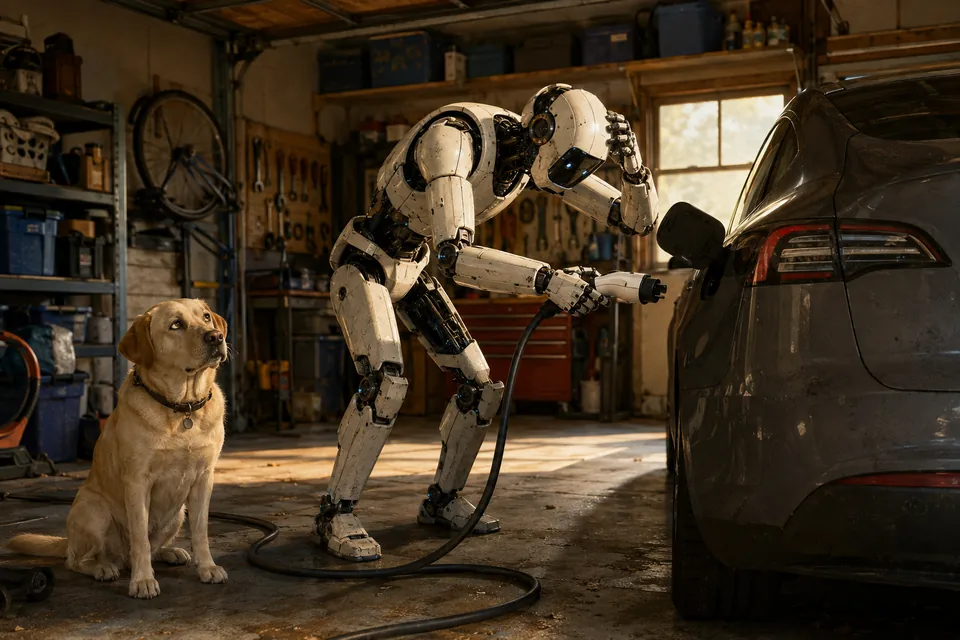 AI illustration · Digital Dynamics
The robot sprints. It backflips. It performs a dance calibrated to make the internet applaud. Then someone asks it to find the charging cable behind a recycling bin, and the future suddenly needs a moment.
1. The demonstration problem
Technology demonstrations are theater with better batteries. They reveal genuine engineering progress, but remove the mess that makes ordinary life ordinary: uncertain lighting, uneven floors, distracted people, and a Labrador who believes every cable is a philosophical challenge.
Running fast is a controlled problem. Plugging in a car is a chain of small judgments. The robot must identify the port, find the cable, understand its orientation, manage resistance, avoid scratching the car, and know when the job is complete.
Laboratories test what a robot can do. Homes test whether it can remain invited.
2. A house fights back
Homes were not designed as robotics laboratories. They are dynamic archives of deferred decisions. Shoes migrate. Chairs move. Children leave objects in places that appear statistically engineered to cause injury.
This matters because physical intelligence is not simply language intelligence with arms. A sentence can be regenerated. A dropped casserole has a more final quality.
What the Internet Is Losing Its Mind Over
Speed is a metric. Usefulness is a system.
A household robot needs reliability, judgment, dexterity, safety, service, and a price that does not require selling the household.
3. What useful looks like
The useful robot may be less theatrical. It may carry groceries, fetch objects, monitor hazards, or help an older adult remain independent. None will produce a viral backflip. That is probably a sign of maturity.
4. The verdict
Humanoid robots are no longer science fiction props. They are early machines entering the expensive, awkward stage between astonishing prototype and dependable appliance.
Can one plug in your car? Under controlled conditions, increasingly yes. Can it do so every rainy Tuesday while navigating a garage full of human decisions? Keep the charger handy.
Sources & further reading
- National Institute of Standards and Technology, robotics safety and performance
- International Federation of Robotics, World Robotics reporting
- Manufacturer technical demonstrations and public specifications